

Late in 2025, a room in San Francisco filled up to hear one simple idea. The next big wave of global AI products could be built by Pakistani talent. This was not a charity pitch. It was not a feel-good speech. It was the founders showing real proof: real companies, real funding, and real customers, all built by engineers in Lahore, Karachi, and Islamabad.
For a long time, Pakistan’s tech story had just one role. We were the reliable supplier. Good engineers, fair prices, and work delivered on time. We built and looked after other people’s products. Most of the time, nobody abroad even knew a Pakistani team was behind the screen.
That story is now changing. And AI is the reason why.
This change matters to everyone. Whether you are a policymaker, a tech professional, an institution, or a university student planning your next few years, it is worth paying attention.
AI in Pakistan is moving from being just a “market” to becoming a real “player.” Here is what that looks like in real life.
From Doing the Work to Owning the Product
The old outsourcing model was useful, but it had a limit. You can only grow so much when you do not own the final product. You sell your hours, and once the project ends, the value ends with it.
AI changes this. It lets Pakistani founders win on skill, ideas, and problem-solving, not just on low cost. That is a big shift. It changes the whole industry from “we will build what you design” to “we built this, and the world wants it.”
The Founders Already Proving It
And the timing is good. Pakistan’s IT exports reached $3.39 billion between July and March of FY2025-26, about 20% higher than the year before. In the same period, freelancer earnings jumped by 58% as AI related work grew fast. The two things you need for an AI economy, talent and demand, are already here.
The Founders Already Proving It
Let us skip the theory and look at who is actually building.
- TaxGPT uses AI to do the boring, slow work of tax and accounting. It was founded by Kashif Ali, and it raised $4.6 million in 2025 to grow, with Pakistani engineers building the core product. This is a simple, smart idea: take one painful job, automate it, and sell it to the world.
- Newton builds AI tools that help dental and healthcare clinics run more smoothly. It raised $3.8 million in seed funding. Its founding engineer says Pakistani engineers are a real strength because of how they solve problems, not because they are cheap.
- Metric, started by Meenah Tariq, Omar Parvez Khan, and Dr. Habiba, built an AI called Max that works like a “financial brain” for small businesses. It helps them understand their numbers and make better decisions. It is the kind of product that can quietly grow across South Asia and the Middle East, even though it started in Lahore.
- Farmdar uses AI and satellite technology to help farmers grow crops in a smarter, more sustainable way. This is the kind of local, real world problem that big global AI companies are not rushing to solve.
- Traversaal.ai works with large companies. It helps them build full AI systems like smart search, AI assistants, and tools that bigger organisations connect to their own software.
The connectors matter too.
Remotebase (Qasim Asad Salam) links Pakistani developers with US startups. Ejad Labs (Mehroz Azam) is working to connect Pakistan’s talent with the wider global AI world. Their message in San Francisco was simple and hopeful: Pakistani professionals can compete with the best, and even lead.
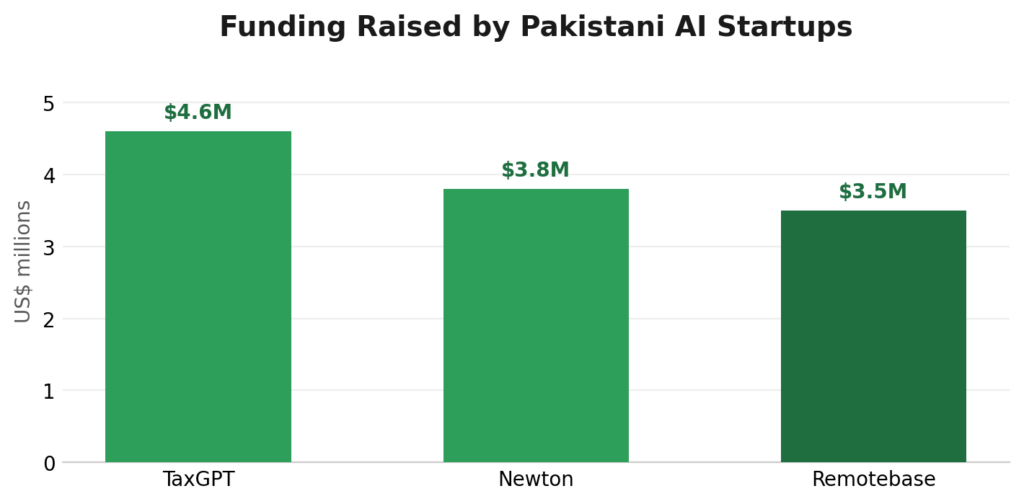
Different fields, same story: Pakistani talent is turning into real products with global reach.
Pakistan’s Quiet Advantage in AI
Here is the part people often miss. Pakistan is not behind in every way. In some ways, it holds cards that other countries do not.
Plenty of talent. Pakistan produces over 25,000 IT graduates every year and ranks in the global top ten for freelance tech talent. The people who can build AI products are already here, in large numbers.
A local edge. An AI tool built for Urdu, Punjabi, Pashto, or for the daily work of a Pakistani small business owner is not something a company like OpenAI is going to build. Only a local founder will make it. And it wins not because it is cheaper, but because it fits so well. Building for local needs is hard, and that difficulty is exactly what protects you. A product that works here will work almost anywhere.
Easier to start than ever. Cloud computing is easy to access. Payments have improved. Remote work is normal now. The old barriers that made it hard to build a world class AI company from Karachi have come down a lot.
Enterprise AI: The Next Big Opportunity
Consumer apps get all the attention. But the bigger money is often in enterprise AI. This is the less flashy but very valuable work of helping large organisations run better.
This is where Pakistani startups are getting strong. They build AI assistants, smart search systems, document tools, and data systems for companies abroad. Banks, hospitals, shops, and delivery companies all need AI in their daily work, and they need partners who can build it well and at a fair price.
It helps to understand the shift behind all this, because it is what makes small teams so powerful today. If this is new to you, start with our guide on what AI agents are and why Pakistan’s tech workforce should pay attention.
A small Pakistani team can now do the work that used to need a whole department. That is a real advantage, and it grows well in global markets.
The Honest Part: What Still Needs Work
Being positive is good, but only if we are also honest. So let us be clear about the gaps.
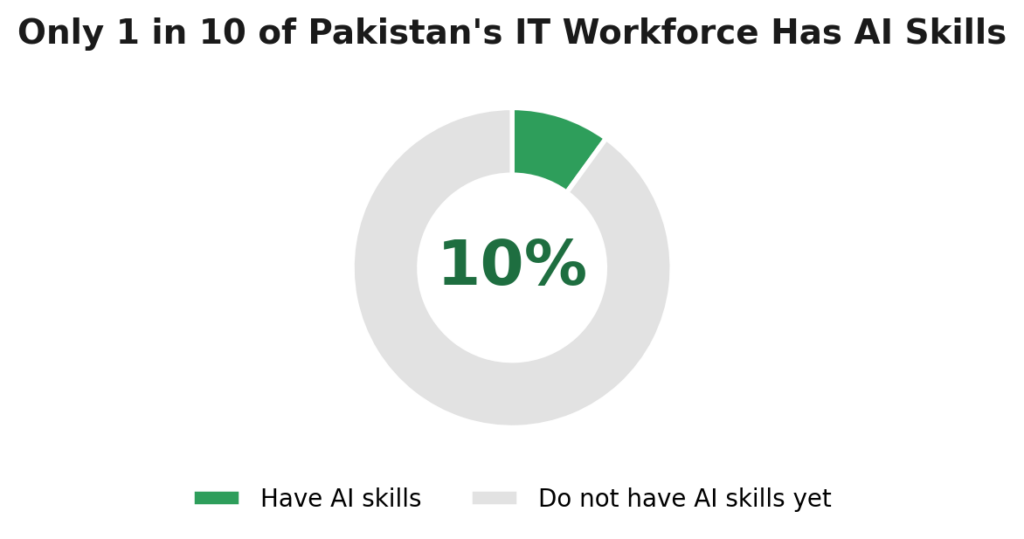
The challenges are real. Electricity is not always reliable, and local computing power is limited. Pakistan also ranks 149 out of 197 for open government data. Local funding for new startups is still thin. And there is a skills gap, because only about 10% of the IT workforce has AI skills right now.
There is also a trap to avoid. Many “AI startups” are just a thin layer on top of a tool like GPT-4, with no special data and no real advantage. These products end up fighting on price until there is no profit left. The real winners build something that is hard to copy: their own data, their own workflow, their own edge.
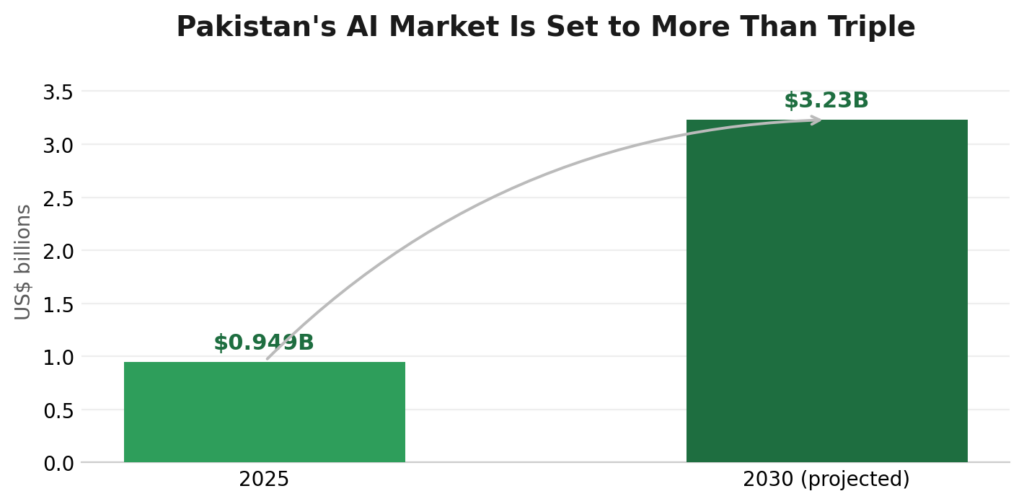
The good news is that the foundations are being built. The government has promised a $1 billion investment in AI by 2030, along with a National AI Policy. This connects to a bigger question about ownership and control, which we cover in What Is Sovereign AI? And Why Should Pakistan Care? https://www.atomcamp.com/what-is-sovereign-ai-and-why-should-pakistan-care/
But the single biggest factor is not policy or money. It is people.
Where Students and Young People Come In
Every startup in this blog depends on one thing: skilled people who can build with AI. That is the bottleneck. And that is also the opportunity.
If you are a university student, this is the most important point in the whole blog. The founders who will shape Pakistan’s AI future are learning these skills right now. And the skills are not a secret. They are Python, machine learning, NLP, computer vision, working with LLMs, building AI agents, and learning how to turn an idea into a product people will pay for. All of this can be learned, and the door is wide open.
This is exactly the gap atomcamp was built to close. We have trained over 6,000 young people and professionals. We work with the Ministry of IT, HEC, Meta, Microsoft, and Huawei, and we partner with universities to build a pipeline of AI talent. We also work hard to bring more women into the field.
If you are a student or fresh graduate, here are a few simple ways to start:
- Have a technical background? The AI Bootcamp covers machine learning, deep learning, NLP, computer vision, generative AI, and building real products you can deploy.
- Coming from a non technical field? The Data Analytics Bootcamp starts you with Excel, Power BI, SQL, and Python. It is a friendly way into the data and AI world.
- Not sure yet? Browse all atomcamp courses and pick the track that fits your goals.
Our graduates now work at companies like Careem, Traversaal.ai, PTCL, SECP, and Ocado Technology in the UK. That is proof that skills built in Pakistan can travel anywhere.
The Takeaway: Pakistan Is a Player Now
The idea that Pakistani founders are at a disadvantage in AI is mostly wrong. The talent is here. The local edge is here. The funding is starting to flow. And the products are already winning customers across the world.
Pakistan does not have to be just “the market that others sell to.” It can be the place where truly useful AI is built, on local terms, for the whole world.
The companies built in 2025 and 2026 will shape AI for the next ten years. The real question is not whether Pakistan can play. It is who will step up to build, and whether that person will be you.
Want to build with AI instead of watching from the sidelines?
Explore atomcamp’s bootcamps and courses https://www.atomcamp.com/course/
Frequently Asked Questions
How are Pakistani startups using AI to compete globally?
They are moving from doing outsourced work to building their own AI products, like vertical SaaS tools, enterprise AI systems, and local language apps, and then selling them around the world.
Why does Pakistan have an advantage in AI entrepreneurship?
Three reasons. First, a large and affordable talent pool, with 25,000+ IT graduates a year and top ten global freelance talent. Second, a local edge in building for Urdu and local needs that global firms ignore. Third, much lower barriers to start, thanks to cheap cloud computing and remote work.
What are the biggest challenges for AI in Pakistan?
Power and computing limits, limited open data, thin local funding, and a skills gap, since only about 10% of the IT workforce has AI skills today. Closing that skills gap is the most important step.
What AI skills should Pakistani students learn?
Python, machine learning, deep learning, NLP, computer vision, working with large language models, and building AI agents. It also helps to learn product and freelancing skills so you can turn those abilities into income. A structured bootcamp is one of the fastest ways to build a strong tech portfolio.
How can university/college students get started with AI in Pakistan?
Start with a structured program that has hands on projects and mentorship. The atomcamp AI Bootcamp is great for technical students, while the Data Analytics Bootcamp is a strong first step for non technical students and career switchers.