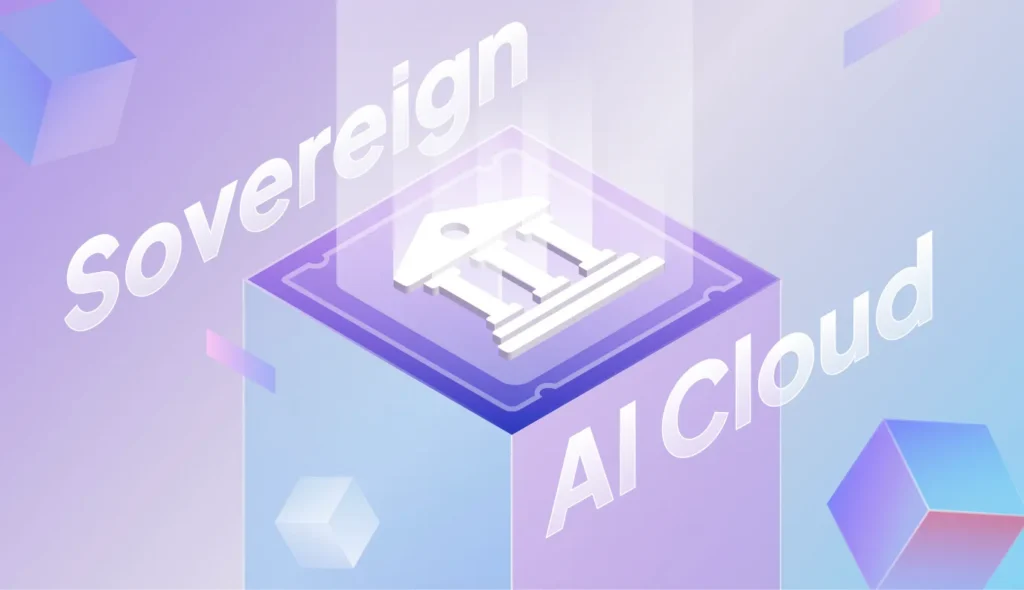
AI is not just a technology anymore. It is a strategic national asset, just like land, military capability, or financial reserves.
That’s where Sovereign AI comes in. And it’s something every government, institution, and tech professional needs to understand right now.
And just like those assets, control over AI determines power. The countries that build and own their AI infrastructure will shape the digital century. The ones that don’t will be governed by the rules of others.

What Is Sovereign AI?
Sovereign AI refers to a country’s ability to develop, own, operate, and govern its own artificial intelligence systems using its own data, infrastructure, and talent, without depending on foreign companies or governments.
Think of it as national sovereignty, but applied to the age of AI.
Right now, when a government hospital, a defence agency, or a public ministry uses a foreign AI cloud service, it is quietly handing over sensitive citizen data and decision-making authority to a foreign jurisdiction. Sovereign AI breaks that dependency.
It’s not just about technology. It’s about control.
Why Is Sovereign AI Important Right Now?
Here’s the thing: the global race for AI sovereignty has already started. And it’s moving fast.
The UAE launched its own large language model, Falcon, in 2023. Saudi Arabia followed with ALLAM. France backed “Mistral”. India has committed billions to national AI infrastructure. Singapore runs AI Singapore (AISG) with full domestic deployment.
These are not experiments. They are deliberate, strategic decisions made by governments that understand what’s at stake.
For Pakistan, this is a real opportunity to lead in South Asia. But that window won’t stay open forever. The longer the delay, the deeper the dependency on foreign systems becomes.
The Five Core Dimensions of AI Sovereignty
Sovereign AI isn’t a single product or a one-time decision. It’s a framework built across five key dimensions.
- Data Sovereignty: Citizens’ and state data stay within national borders and under national legal jurisdiction. No foreign server. No foreign law applied to Pakistani data.
- Compute Sovereignty: AI models are trained and served on hardware that is nationally owned or controlled, not rented from a company that can cut access overnight.
- Model Sovereignty: Governments own or can fully audit the AI models making decisions that affect citizens. A system you can’t inspect is a liability, not an asset.
- Regulatory Sovereignty: AI policies, safety standards, and ethics rules are set domestically, shaped by local values and needs, not imported from abroad.
- Talent Sovereignty: Local engineers, researchers, and institutions build and maintain these systems. The expertise stays inside the country.
Together, these five dimensions form the foundation of a truly independent AI strategy.

How Does a Sovereign AI System Actually Work?
A Sovereign AI system isn’t a single product. It’s a layered technology stack, where each layer adds a new level of national control and resilience.
Here’s how the architecture breaks down:
- Layer 1: Compute Infrastructure: On-premise GPU servers and national data centres, owned or leased by the state. Data never leaves the country.
- Layer 2: Locally Deployed LLMs: Open-source or custom large language models, like LLaMA, Mistral, or Falcon, deployed on domestic servers instead of foreign clouds.
- Layer 3: AI Applications and APIs: Sector-specific tools built on top of those models: healthcare triage systems, legal document review, public service chatbots, procurement monitoring.
- Layer 4: Governance and Compliance: Audit trails, bias monitoring, national AI policy enforcement, and citizen-rights protection built directly into the system.
The important thing to know? Each layer can be implemented independently. You don’t need everything at once. Starting with locally deployed LLMs, for example, can show real, measurable results within months, not years.

What Does Deploying an LLM Locally Actually Mean?
A Large Language Model (LLM) is the AI engine behind tools like ChatGPT, Claude, Copilot, and Gemini. Today, when a government employee uses any of these tools, every query and every document they upload travels to servers in the United States or Europe.
Local deployment changes that entirely.
Here’s what the process looks like in practice:
- Model Selection: An open-weight AI model, such as Meta’s LLaMA 3, Mistral, or a fine-tuned Urdu model, is downloaded and installed on servers physically located inside Pakistan.
- On-Premise Hosting: The model runs on GPU-enabled servers in a secure national data centre, government-owned, co-located, or operated under a national cloud framework.
- Domain Customisation: The model is fine-tuned on locally relevant data: Urdu language corpora, Pakistani legal frameworks, NADRA identity formats, provincial health records.
- Secure Access: A managed API gateway lets government departments use the AI, just like ChatGPT, but all traffic stays within the national network perimeter.
- Full Auditability: Every interaction is logged, auditable, and subject to national data retention and privacy law.
A real example for Pakistan: Imagine a Federal Tax Officer asking an AI to summarise income declarations and flag anomalies. With a foreign cloud LLM, sensitive fiscal data leaves Pakistan. With a locally deployed LLM, the computation happens inside the country, the answer arrives on the officer’s screen, and the data never crosses a border.

What Are the Risks of Using Foreign Cloud AI?
Convenience is great. But for government institutions, relying on foreign AI platforms carries risks that are structural, legal, and strategic. Here are the six most critical ones:
1. Data Leakage and Espionage: Queries sent to foreign servers can include classified defence information, citizen biometrics, or economic intelligence. Under the US CLOUD Act, American authorities can legally compel tech companies to hand over data stored on their servers, including data from foreign governments.
2. Foreign Jurisdictional Override: Terms of service for GPT-4, Gemini, and similar tools place dispute resolution in US courts. Pakistan has no legal recourse if data is misused, sold, or subpoenaed by a foreign power.
3. Operational Shutdown Risk: If Pakistan ever faces geopolitical pressure or sanctions, access to these services can be revoked overnight. We’ve already seen this happen with Huawei and Russian cloud services.
4. Cultural and Linguistic Bias: All dominant LLMs are trained primarily on English-language Western data. They misrepresent Pakistani law, Islamic jurisprudence, Urdu idiom, and regional governance norms, leading to incorrect or culturally inappropriate outputs in critical decisions.
5. Lack of Accountability: When a foreign AI makes a wrong decision, denying a citizen a benefit, misclassifying a loan, flagging innocent activity, the Pakistani state has no mechanism to audit, challenge, or override that black-box model.
6. Perpetual Economic Drain: Pakistan currently pays in hard foreign currency for AI access. Sovereign AI converts this ongoing expenditure into a one-time domestic investment, creating local jobs and keeping value inside the national economy.

How atomcamp Is Helping Build Pakistan’s Sovereign AI Future
We’re uniquely positioned to serve as Pakistan’s sovereign AI partner, combining deep technical expertise, policy literacy, and on-ground implementation capability.
Our engagement model works in six practical phases:
- Phase 1: Readiness Assessment: Technical needs assessment across target ministries and agencies, identifying high-value AI use cases.
- Phase 2: Infrastructure Setup: Procurement and configuration of on-premise GPU infrastructure or a secure national cloud arrangement.
- Phase 3: LLM Deployment: Deployment of open-weight models (LLaMA 3.1, Qwen2.5, Mistral, or a Pakistan-specific fine-tune) on secure domestic servers.
- Phase 4: Localisation: Fine-tuning on Urdu, Pashto, Sindhi, and domain-specific government datasets to maximise regional accuracy.
- Phase 5: Application Layer: Sector-specific AI assistants, tax analysis, legal document review, healthcare triage, procurement monitoring.
- Phase 6: Capacity Building: Training of 500 to 1,000 government AI champions through atomcamp’s learning platform.
Also, atomcamp brings established relationships with federal and provincial government departments, a proven AI talent pipeline, and a commitment to ethical, auditable AI that aligns with Islamic principles and Pakistani law.

Sovereign AI Is Not a Luxury, It’s a Necessity
Every month Pakistan delays building its sovereign AI infrastructure, its institutions become more dependent on foreign systems, more exposed to data risks, and further behind nations that are already investing.
This isn’t about nationalism. It’s about governance. It’s about protecting citizen data. It’s about keeping national security decisions in national hands. And it’s about building a 21st-century economy that works for Pakistan.
The question is no longer whether Pakistan should pursue Sovereign AI. The question is whether it will do so on its own terms or wait until the choice is made for it.
How atomcamp Can Help You Get Started
Whether you’re a government official, a tech professional, or an institution looking to understand and act on AI sovereignty, atomcamp can guide you.
From AI awareness sessions and policy advisory to full-scale LLM deployment and capacity building, we offer end-to-end support for Pakistan’s sovereign AI journey.
Let’s build Pakistan’s AI future. On Pakistani soil. Under Pakistani law. By Pakistani talent.