
- Top #1 Rated Online AI Course
Artificial Intelligence Bootcamp
Join atomcamp’s AI Bootcamp (Cohort 20) — a hands-on, practical program designed to take you from beginner to job-ready in just 3 months.
Fee: PKR 75,000
Online
Google Meet
15th December
Start Date
TA Support
TA Sessions
Online
Google Meet
15th December
Start Date
TA Support
TA Sessions
3 Months
Duration
7:00 - 9:00PM
Monday, Tuesday, Thursday
Freelancing
Sessions
3 Months
Duration
7:00 - 9:00PM
Monday, Tuesday, Thursday
Freelancing
Sessions
At atomcamp, we don’t just teach AI — we help you build a career.

Dr. Naveed Iftikhar
Co-Founder atomcamp & AI Strategist










Build Real-World AI Skills in 3 Months
This three-month AI Bootcamp is designed to equip you with the technical skills and confidence to build and deploy intelligent systems from the ground up.
You’ll gain hands-on experience in Python programming, Machine Learning, Deep Learning, Generative AI, and Large Language Models (LLMs), along with practical modules in Natural Language Processing (NLP), Computer Vision, and AI Agents.
The program also covers AI Operations (MLOps), Large Language Model Operations (LLMOps), Prompt Engineering, Context Engineering, and multimodal AI applications—helping you understand how modern AI systems integrate text, images, automation, and scalable AI deployment. Throughout the bootcamp, you’ll work on real-world projects that bridge theory with practice, guided by mentors with deep academic and industry expertise.
By the end of the program, you’ll have a professional portfolio, an industry-recognized certificate, and the skills to confidently launch or advance your career in Artificial Intelligence.
Join us and become future-ready in the era of AI innovation.
- Eligibility criteria
Currently enrolled or have graduated with a bachelor’s degree in:
- Computer Science or related fields
- Any Engineering Discipline (Mechanical, Electrical, Civil etc)
- Comprehensive Curriculum That Powers Impact
Course Curriculum
Python Basics
- Introduction to Python: history, features, and advantages
- Expressions and operators: arithmetic, assignment, comparison, and logical
- Understanding type() function and type inference
- Introduction to data structures: lists, tuples, and dictionaries
- Working with arithmetic operators: addition, subtraction, multiplication, division, modulus, and exponentiation
- Using comparison operators: equal to, not equal to, greater than, less than, etc.
- Logical operators: and, or, and not
- Exploring advanced data types: sets and strings manipulation.
Expressions, Conditional Statements & For Loop
- Evaluating expressions: operator precedence and associativity
- Introduction to conditional statements: if, elif, and else
- Executing code based on conditionals.
- Understanding the flow of control in conditional statements
- Iteration using the for loop: range(), iteration over lists, and strings.
While loop, Break and Continue Statements, and Nested Loops
- Working with while loop: syntax, conditions, and examples
- Combining loops and conditionals
- Using the break statement to exit loops prematurely.
- Utilizing the continue statement to skip iterations.
- Implementing nested loops for complex iterations
Functions
- Introduction to functions: purpose, advantages, and best practices
- Defining and calling user-defined functions
- Parameters and arguments: positional, keyword, and default values
- Return statement and function output.
- Variable scope and lifetime
- Function documentation and code readability
Exception Handling and File Handling
- Understanding exceptions: errors, exceptions, and exception hierarchy
- Handling exceptions using try-except blocks: handling specific exceptions, multiple exceptions, and else and finally clauses.
- Raising exceptions and creating custom exception classes
- File handling in Python: opening, reading, writing, and closing files.
- Working with different file modes and file objects
Learn how to design, automate, and deploy AI agents using powerful no-code tools
n8n
- Workflow automation with drag-and-drop agents
- Connecting APIs, webhooks, and data sources
- Hands-on: Build an agent that automates research or reporting
Power Automate Desktop
- Automating business workflows with AI triggers
- Integration with Microsoft 365 and enterprise apps
- Hands-on: Create an agent that responds to events (emails, forms, data updates)
Azure AI Foundry
- Deploying AI models and services on Azure without code
- Connecting cognitive services (vision, speech, language)
- Hands-on: Build an AI agent using Azure’s prebuilt models
Microsoft Copilot Studio
- Customizing Microsoft Copilot with no-code workflows
- Building conversational AI experiences for Teams and Office apps
- Hands-on: Design a domain-specific Copilot for business tasks
Introduction and Missing Value Analysis
- Introduction to Exploratory Data Analysis (EDA)
- Importance of EDA in data analysis
- Steps involved in EDA
- Handling missing values: identification, analysis, and treatment strategies • Imputation techniques for missing values
Data Consistency, Binning, and Outlier Analysis
- Data consistency checks using fuzzy logic
- Binning and discretization techniques for continuous variables
- Outlier detection and analysis methods
- Handling outliers: techniques for treatment or removal
Feature Selection and Data Wrangling
- Importance of feature selection in EDA
- Feature selection techniques: filter methods, wrapper methods, and embedded methods
- Data wrangling: cleaning and transforming data for analysis
- Handling categorical variables: encoding techniques
Inference, Hypothesis Testing, and Visualization
- Inference and hypothesis testing in EDA
- Common statistical tests: t-test, chi-square test, ANOVA, etc.
- Visualization techniques for EDA: histograms, box plots, scatter plots, etc.
- Hands-on practical session for complete EDA using a dataset
Mathematical Concepts
Linear Algebra:
- Vectors, matrices, operations, and their applications in data science.
- Introduction to numpy for matrix operations.
Introduction to numpy:
- Why numpy is the preferred library for numerical operations in Python.
- Basic numpy operations: creating arrays, array indexing, array slicing.
- Matrix operations using numpy: matrix multiplication, finding determinants, solving linear equations.
Probability and Statistics
- Probability Theory:
- Basic probability, rules, and distributions (normal, binomial, Poisson).
- Random variables, expectations, and variance.
Descriptive Statistics:
- Measures of central tendency (mean, median, mode).
- Measures of variability (range, variance, standard deviation)
Introduction to pandas and scipy
- Using pandas for data manipulation and summary statistics.
- scipy for performing hypothesis tests and building confidence intervals.
- Visualization with seaborn and matplotlib to understand data distributions and relationships.
Probability and Statistics II
Inferential Statistics:
- Sampling distributions and the Central Limit Theorem.
- Confidence intervals and hypothesis testing.
Correlation and Regression:- Scatter plots, correlation coefficients.
- Simple linear regression analysis.
Introduction to Seaborn and Matplotlib- Visualization of correlation matrices and scatter plots to identify relationships between variables.
- Advanced plotting techniques such as pair plots, heatmaps, and regression plots to extract deeper insights from data.
Overview of Machine Learning
- Supervised, unsupervised, and reinforcement learning.
- Machine learning workflow from data collection to model deployment.
- Introduction to Python libraries essential for ML (Scikit-learn, TensorFlow, PyTorch)
Supervised learning and Linear Regression
- Linear Regression: Concept, loss function, evaluation metrics (MSE, R²)
- Building a Linear Regression model in scikit-learn
- Visualizing predictions vs actuals
Machine Learning Performance Metrics and Naive Bayes
- Evaluation metrics for classification problems: accuracy, precision, recall, F1 score, etc.
- Introduction to Naive Bayes algorithm and its applications
- Implementing Naive Bayes for classification tasks
Logistic Regression, SVM, Decision Trees, and Random Forests
- Logistic Regression: theory, interpretation, and applications
- Support Vector Machines (SVM): concepts, kernels, and use cases
- Decision Trees: construction, pruning, and interpretability
- Random Forests: ensemble learning and feature importance
- Bagging and Boosting: techniques for improving model performance
Clustering Introduction, Partitioning Algorithms, and Cluster Evaluation
- Introduction to clustering: unsupervised learning technique
- Partitioning algorithms: K-means, K-medoids
- Hierarchical clustering: agglomerative and divisive approaches
- Density-based clustering: DBSCAN, OPTICS
- Cluster evaluation metrics: silhouette coefficient, Davies-Bouldin index
Regression and Evaluation of Regression Methods
- Introduction to regression analysis
- Linear regression: assumptions, interpretation, and model evaluation • Evaluation metrics for regression: mean squared error, R-squared, etc.
- Other regression methods: polynomial regression, ridge regression, lasso regression
Introduction to Deep Learning
- Overview of deep learning, its importance in computer vision, key concepts, and architectures.
- Code along session for building Deep Neural Network from scratch
Deep Learning Hyperparameter Tuning
- Strategies for optimizing hyperparameters like learning rate, batch size, and regularization to improve model performance.
Introduction to Generative AI and Multimodal Models
- Overview of Generative AI and its impact on various industries.
- Understanding multimodal models and how they differ from single-modality models.
- Exploring the OpenAI API: Capabilities and applications for text, speech, and image-based AI.
Speech Synthesis and Conversational Agents
- Objective: Dive into text-to-speech (TTS) and speech-to-text (STT) models and explore conversational AI with agent frameworks.
- Overview of text and voice synthesis technologies.
- Introduction to Eleven Labs and Heygen: Creating high-quality audio and speech synthesis.
- Using OpenAI API for speech synthesis and understanding its capabilities
Advanced Agent Development with LangChain
- Basics of LangChain and its role in agent-based AI.
- Building, customizing, and deploying agents using LangChain.
- Exploring integration of LangChain with other APIs for multimodal interactions, including OpenAI API for image and text generation.
Building Complex Agent-Based Applications with CrewaI, Synthesia, and OpenAI
- Introduction to CrewaI: Building intelligent agents for various tasks.
- Synthesia for video and visual content generation in AI-driven applications.
- Using OpenAI API to generate multimodal content (text, images, and speech).
- Building a final project: Integrate multiple APIs to create a multimodal generative application.
Conceptual Overview
- Understand the distinct roles and responsibilities of data scientists and data engineers within projects.
Data Sourcing with Python
- Extracting data from sources like PostgreSQL, MongoDB, APIs, web scraping, and IoT devices.
Databricks Tour
- Get introduced to Databricks as a platform for big data processing and machine learning.
Big Data Handling for Data Science
- Process large-scale datasets using Apache Spark within a distributed environment.
MLflow
- Learn to track experiments and ensure reproducibility in machine learning workflows
Introduction to Convolutional Neural Networks (CNNs)
- Explanation of CNNs, their architecture, and their role in image processing.
- Codel along session on Convolutional Neural Networks
Building Custom Image Classification Models
- Step-by-step guide to creating and training a custom image classifier using a CNN.
Transfer Learning and Introduction to Object Detection
- Introduction to transfer learning, its applications, and an overview of object detection techniques.
- Hands on with YOLO Object Detection
- Practical session on using the YOLO (You Only Look Once) algorithm for object detection.
Custom Training YOLO model
- Detailed guidance on training a YOLO model with a custom dataset for specific object detection tasks.
Using State-of-the-Art Models for Real-World Applications
- Exploring and implementing advanced models in computer vision for practical use cases.
Introduction to OpenCV
- Introduction to OpenCV, its libraries, and its importance in computer vision tasks.
Image Pre-processing and Pre-build Algorithms in OpenCV
- Hands-on session on image pre-processing techniques and using built-in algorithms in OpenCV.
Advance guided project with OpenCV
- Capstone project where Students apply learned techniques in a guided project using OpenCV.
Introduction to NLP and Text Normalization
- Overview of Natural Language Processing (NLP)
- Techniques for text normalization: lowercasing, punctuation removal, etc.
- Basics of tokenization and stopword removal
Text Representation and Tokenization
- Introduction to vectors in NLP: Bag of Words and Count Vectorizer
- Basics of tokenization and stopword removal
Stemming, Lemmatization, and N-gram Language Models
- Understanding and applying stemming and lemmatization
- Introduction to N-gram language models
- Introduction to vectors in NLP: Bag of Words, Count Vectorizer, and TF-IDF
Markov Models and Language Model Evaluation
- Basics of Markov models in NLP
- Overview of Text Classification
- Techniques for evaluating language models: probability smoothing and performance metrics
- Introduction to Naive Bayes and Sentiment Classification
Advanced Classifiers and Vector Semantics
- Generative vs. discriminative classifiers
- Understanding vector semantics and embeddings
- Introduction to neural word embeddings: Word2Vec and GloVe
Deep Learning for NLP and Sequence Models
- Overview of deep learning techniques for NLP
- Applying supervised and unsupervised learning methods to NLP tasks
- Exploring sequence of words in NLP tasks
Transformers and Large Language Models
- Understanding the architecture and mechanisms of transformers
- Overview of large language models (LLMs) and their capabilities
Training and Fine-Tuning LLMs
- Techniques for training large language models
- Fine-tuning pre-trained LLMs for specific tasks
Foundations & Setup
- MLOps lifecycle vs DevOps
- Core principles: automation, reproducibility, scalability
- Tools overview: GitHub, Docker, Hugging Face, W&B, FastAPI, GCP
Git & Version Control
- Git fundamentals for ML workflows
- Managing code, datasets, and model versions
- Best practices for collaborative AI projects
Docker & Containerization
- Why containers matter for ML/LLM projects
- Writing efficient Dockerfiles
- Packaging training and inference environments
Weights & Biases (W&B)
- Experiment tracking & model monitoring
- Dataset and artifact logging
- Visualization dashboards for ML pipelines
CI/CD with GitHub Actions
- Automating training & testing workflows
- Building and pushing Docker images
- Secure secrets management in pipelines
FastAPI Fundamentals
- Designing REST APIs for ML/LLM models
- Model loading & inference endpoints
- Containerizing APIs for portability
Backend + Frontend Integration with W&B Model Fetching
- Serving models from Hugging Face Hub or W&B Artifacts
- Connecting backend inference with frontend UI
- Hands-on: Build a simple web app with model integration
Deployment on Google Cloud
- Deploying with Cloud Run & App Engine
- Automating deployment using GitHub Actions + gcloud CLI
- Validating endpoints & scaling services
Pipeline Integration & Final Project
- Orchestrate data→train→API→deploy
- Triggers: PRs, tags, schedules
- Hands-on: End-to-end pipeline demo and presentation
Email Writing
- Basics of Professional Email Communication: Structure, tone, and etiquette.
- Writing Effective Subject Lines: Techniques to ensure your emails are opened.
- Emails for Networking: Approaching professionals and mentors in data science/AI.
- Follow-up Emails: Strategies for following up without being intrusive.
Report Writing + Presentations
- Structure of a Data Science Report: Elements including abstract, methodology, results, and conclusion.
- Visualizing Data: Incorporating charts, graphs, and other visual tools to enhance comprehension.
- Creating Engaging Presentations: Tips for PowerPoint, storytelling, and engaging your audience.
- Presentation Skills: Delivering your message confidently, handling Q&A sessions.
LinkedIn Optimization
- Building a Professional Profile: Key components of a LinkedIn profile for data science/AI professionals.
- Networking Strategies: Connecting with industry professionals and joining relevant groups.
- Content Sharing and Creation: Establishing thought leadership by sharing insights, articles, and engaging with community content.
Resume/CV Writing
- Tailoring Your Resume for Data Science/AI: Highlighting relevant skills, projects, and experiences.
- Action Verbs and Quantifiable Achievements: Demonstrating impact in previous roles or projects.
- Design and Layout: Making your resume/CV visually appealing and easy to read.
Freelancing Series
- Getting Started with Freelancing: Platforms for data science/AI freelancers, setting up a profile.
- Finding Projects and Clients: Strategies to secure freelance work and build a portfolio.
- Pricing Your Services: Understanding market rates and value-based pricing.
- Client Management: Communicating effectively and managing expectations.
Kaggle for Data Science
- Introduction to Kaggle: Overview of the platform, competitions, datasets, and notebooks.
- Participating in Competitions: Tips for success, collaboration, and learning from the community.
- Building a Portfolio: Using Kaggle to showcase your skills and projects to potential employers.
GitHub
- Why GitHub for Data Scientists: Importance of version control and code sharing.
- Creating and Managing Repositories: Best practices for organizing and documenting projects.
- Collaborating on Projects: Contributing to open-source projects and collaborating with others.
- GitHub as a Portfolio: Presenting your work and contributions to potential employers.
How to Crack AI Interviews
- Understanding the Interview Process: Types of interviews (technical, behavioral, case studies).
- Preparing for Technical Interviews: Common questions, coding challenges, and statistical questions.
- Behavioral Interview Preparation: Crafting your story, STAR method for responses.
- Mock Interviews: Practicing with peers or mentors to gain confidence.
Global Market Understanding
- Data Science/AI Trends: Understanding global trends and emerging technologies.
- Cultural Competence: Working in multicultural teams and serving diverse user bases.
- Regulatory Environment: Overview of data privacy laws and ethical considerations in different regions.
AI Product Development
- From Idea to Product: Ideation, validation, and development processes.
- User-Centric Design: Incorporating user feedback and UX/UI principles.
- Product Management for AI: Unique challenges in managing AI projects, iteration, and deployment.
- Metrics and Performance: Evaluating the success and impact of AI products.
Intro to Data Commons
- Understanding Data Commons: Concept, importance, and examples.
- Accessing and Contributing to Data Commons: Guidelines and best practices.
- We help graduates find jobs, internships, and freelance opportunities.
Complete our Bootcamp and Become Job Ready






- Your Roadmap to AI Career Success
Career Opportunities After AI Bootcamp
- AI Engineer
- Machine Learning Engineer
- Generative AI Engineer
- Deep Learning Engineer
- Computer Vision Engineer
- NLP Engineer
- AI Research Associate
- Applied AI Engineer
- Agentic AI Engineer
- MLOps Engineer
- AI Product Engineer
- Data & AI Consultant
- It's not just Learning - It's a Transformation
Why Choose AI Bootcamp?
This isn’t theory-heavy learning — it’s practical AI in action. Build models, deploy solutions, and graduate with skills companies actually hire for.
Project-based learning
Industry-relevant, future-focused AI curriculum
Personalized coaching
Get guidance and support customized to your learning needs.
Industry-relevant tools and technologies
Work with the same tools used by professionals today.
Community Support & Mentorship
Get guidance and support customized to your learning needs.
Career Support & Job Prep
Get help with resumes, interviews, and job searches to boost your chances of getting hired.
Ongoing Assessments & Feedback
Stay on track with regular assessments and clear feedback.
- Skills that get you hired.
What You'll Learn
Python for AI and Machine Learning
Deep Learning & Neural Networks
Computer Vision Fundamentals
Natural Language Processing (NLP)
Unsupervised Machine Learning Algorithms
Data Analysis & Exploratory Data Analysis (EDA)
Multimodal AI and Generative AI
Agentic AI & AI Agents
LangChain & LLM Integrations
Model Training & Fine-Tuning
Supervised Machine Learning Algorithms
Feature Engineering & Model Optimization
Large Language Models (LLMs)
Model Evaluation
MLOps & Model Deployment
FastAPI & API Development
Feature Engineering & Model Optimization
Mathematics for AI (Linear Algebra, Probability, Statistics)
- Join a free demo class and see how we make learning simple and fun!
Not Sure How We Teach? Take a Demo Class.
- We train professionals from leading companies to excel in AI.
We train Professionals from top organizations across Industries.






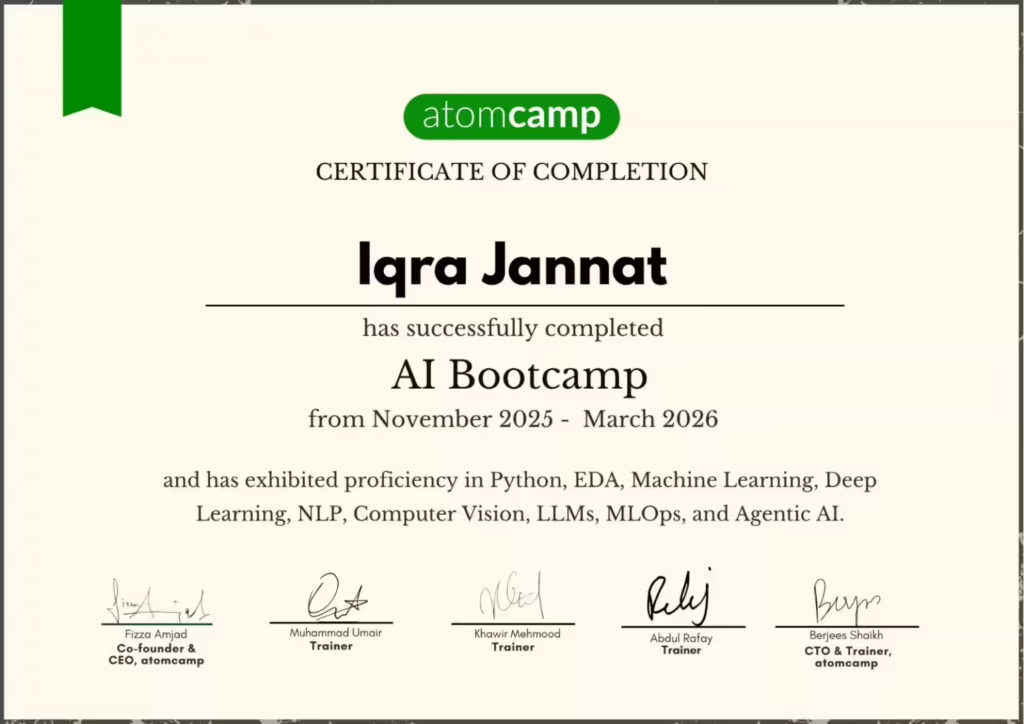
Earn a Verified Certificate of Completion
Earn an AI certificate, verifying your skills. Step into the market with a proven and trusted skillset.
- Mentorship That Makes the Difference
Meet Our Incredible Trainers
Our trainers are experienced industry professionals who have worked with leading global companies such as Microsoft and Google. They bring real-world business experience into the classroom and focus on teaching practical, in-demand skills aligned with today’s job market.
Some of our trainers have teaching experience at world-renowned universities such as Stanford and MIT. Others are currently working in countries like Australia and the Middle East, ensuring that our students learn according to international standards and global best practices.
This strong combination of industry expertise and international exposure ensures that you learn from professionals who understand both academic foundations and real business applications.
When you train with us, you gain practical knowledge, confidence, and career-focused skills that prepare you for global opportunities and professional success.












Master AI & Power What's Next.
Learn real-world skills, get certified, and join a growing community that’s shaping the data-driven world.
10,000+
Global Community
8,000+
Successful Graduates
80%
Job Placement
The future of work isn't about being replaced by AI; it's about being hired because you can use it.
Stop writing resumes and start writing code. Grow your career with us.
Pricing Plan
Pick a plan that fits your needs and budget.
Standard Monthly
PKR 30,000
Monthly Payment
For 3 Months
Lumpsum
PKR 75,000
Advance Payment
For 3 Months
Women Discount
PKR 65,000
Standard Monthly: PKR 25,000
For 3 Months
- Expert mentors, real-world skills—your journey starts here.
Our Guest Speakers

Allen Roush

Yousaf Husni

Muazma Zahid

Adnan Hashmi

Jehangir Amjad

Moshood Yahaya

Mominah Asif

Zain ul Hassan
- Got questions? We've got clear, simple answers to help you out.
Frequently Asked Questions
Structure & Schedule:
The bootcamp runs for 3 months. You’ll need around 6–8 hours each week for live classes and assignments, plus 1 to 2 hours daily practice to strengthen your skills and stay consistent.
Classes are conducted live on Google Meet, where you can interact directly with the trainer and take part in group activities.
Our live sessions are interactive, but don’t worry — if you miss a class, you’ll get the recording and can watch it anytime at your own pace.
Yes, each topic includes small assignments and one final project so you can practice what you learn.
After Completion:
Yes, you’ll get lifetime access to course recordings and resources.
You’ll become part of the atomcamp alumni network, where you can access exclusive job opportunities, events, and continuous learning resources.
Fees & Payment:
You can view the latest fee details on our website. The fee covers live classes, mentorship, recordings, and your completion certificate.
We’re proud to offer a special discount exclusively for women as part of our commitment to empowering more women to learn, grow, and build successful careers in Artificial Intelligence.
This initiative is designed to make our AI Bootcamp more accessible, helping more women gain in-demand AI skills through hands-on training, expert mentorship, and real-world projects. If you're eligible, we’d love to support you on your journey into AI.
Yes, installment options are available to make it easier for you to join the program.
If you request a refund within the first week of enrollment, you’ll receive a full refund. After one week, refunds are processed according to our refund policy and applicable conditions.
You can email us anytime at admissions@atomcamp.com or call us at +92 302 2278371 between 8:00 AM and 6:00 PM. Our team will be happy to assist you.
Career & Outcomes:
Yes. The program includes career guidance, freelancing training, and portfolio development to make you job-ready.
Yes, you’ll create a professional portfolio featuring your AI projects — a key step to stand out in job or freelance applications.
Yes. We train you on how to start freelancing, create profiles, and attract clients using your AI skills
You can apply for roles like Machine Learning Engineer, AI Developer, or Prompt Engineer, depending on your interests and skills.
Yes. You’ll receive mentorship from AI professionals and career support to help you grow in your career.
Language & Accessibility:
The bootcamp is bilingual — conducted in Urdu and English mix, so learners from all backgrounds can easily understand.
Yes, students from anywhere in the world can join online. The classes are bilingual (Urdu and English), so it’s best if you understand Urdu to follow along comfortably
You’ll have access to dedicated WhatsApp and email support for any queries during the bootcamp.
TA Support:
You’ll have full support from our Teaching Assistants (TAs) throughout the course. They help you with assignments, technical issues, and project guidance so you never feel stuck.
You can reach out to them from 8am to 8pm through the WhatsApp group or by email. They’re active during and after class hours to make sure your questions are answered quickly.
Yes. TAs guide you step by step through your project work — from planning your idea to completing it successfully.
Yes, you can request one-on-one support if you need extra help understanding a topic or solving a technical problem.
Our Teaching Assistants are atomcamp graduates and professionals who have already completed similar programs and now support new learners with practical guidance.