
In-person Workshop at GIKI Campus, Swabi
Agentic AI Workshop

atomcamp, in collaboration with Ghulam Ishaq Khan Institute (GIKI), is organizing a 2-day in-person workshop at GIKI Campus, Swabi.
This hands-on workshop focuses on Agentic AI architectures and Retrieval-Augmented Generation (RAG). It is designed for students, developers, and data professionals who want to move beyond basic LLM API usage and learn how to build context-aware AI systems using LangChain and modern agent frameworks.
Fee: PKR 20,000
- 18th & 19th April
- 10:00 AM - 04:00 PM (Saturday, Sunday)
- Accommodation is available on campus. Students may stay in hostel common rooms, or choose the GIKI Guest House (paid accommodation).
- ◉ For more information, please contact us at admissions@atomcamp.com
STANDARD
-
For atomcamp & GIKI Alumni
PKR: 10,000
- Prerequisite
- Proficiency in Python and basic understanding of LLM APIs (OpenAI/Anthropic)
- Accommodation at GIKI
- For Students:
Complimentary shared hostel accommodation(No Charges) - GIKI Guest House
PKR 5,500 per room per night





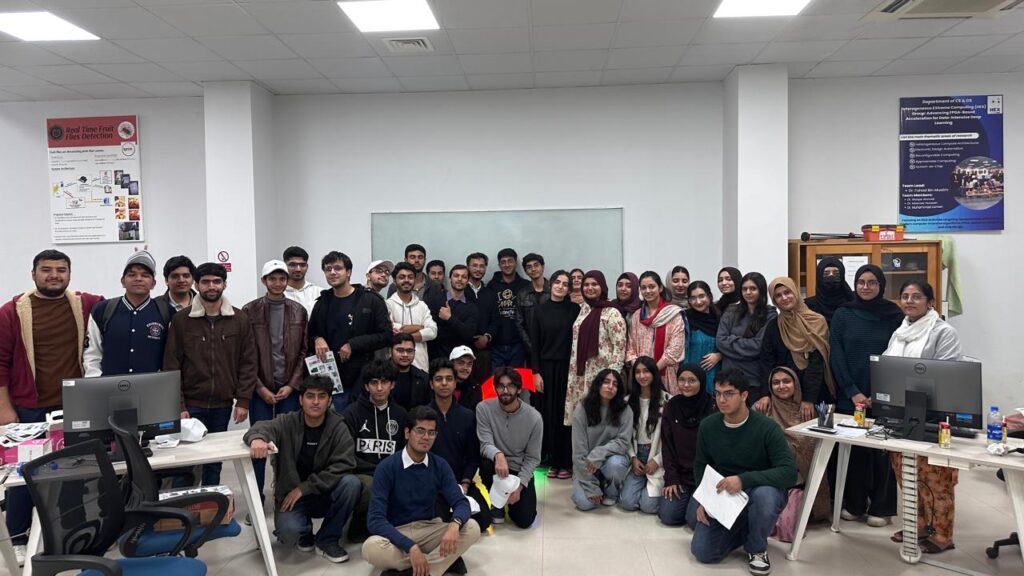
A 2-day in-person workshop, organized by atomcamp in collaboration with Ghulam Ishaq Khan Institute (GIKI), Swabi, is a hands-on program designed to help students, and professionals transition from simple generative AI use cases to structured, intelligent AI systems.
Across two hands-on days, you’ll learn how modern AI agents think, plan, remember information, and use tools. You’ll also build Retrieval-Augmented Generation (RAG) pipelines that allow AI models to answer questions using your own data instead of guessing.
The focus will be on the practical application of agentic ai tools and concepts. You will work with LangChain, vector databases, memory systems, and real implementation patterns. At the end of Day 2, you will have built a working Knowledge Agent that can understand and respond to queries from a private dataset.
This workshop is ideal for developers, students, and professionals building AI products, ai solutions, copilots, or automated workflows.
Here’s What You’ll Learn:
- How modern AI agents reason, plan, and act
- Designing memory-aware AI systems
- Building RAG pipelines for private data
- LangChain & LCEL best practices
- Architecting AI systems that scale beyond demos
Curriculum
The Shift from RAG to Autonomy: Why Agents?
From static chatbots to autonomous AI systems
Motivation behind Agentic AI and enterprise value
Limitations of traditional RAG pipelines
The P-P-A-R-M Framework
Perception: Understanding inputs and environment
Planning: Task decomposition and goal setting
Action: Tool usage and execution
Reflection: Self-evaluation and correction
Memory: Short-term and long-term context
Architectural Foundations
Layers of reasoning, orchestration, and execution
Designing scalable agent workflows
Separation of concerns in agent systems
Hands-On Lab: Build and configure a basic AI agent with defined identity, goals, and structured prompts.
LangChain Core Concepts
LangChain Expression Language (LCEL)
Building composable AI chains
Prompt templates and orchestration
Managing state with ChatMessageHistory
RAG Data Pipeline
Document loading and preprocessing
Text chunking strategies
Vector embeddings and similarity search
Context injection into prompts
Vector Databases
Introduction to vector databases
Implementing ChromaDB
Indexing and retrieval workflows
Hands-On Lab: Create a Private Knowledge Bot that answers questions from uploaded documents using semantic search.
Tool Binding & Agent Types
Converting Python functions into AI tools
Pydantic validation for tool inputs
Zero-shot, Conversational, and Structured agents
Error Handling & Self-Correction
Tool invocation strategies
Self-correction loops
Handling failed actions gracefully
Hands-On Lab: Develop an AI agent that invokes external APIs and executes real-world tasks with validation.
Agent Roles & Collaboration
Defining agent roles and backstories
Researcher, Writer, Reviewer personas
Context sharing between agents
Task Orchestration
Sequential and hierarchical workflows
Designing collaborative pipelines
Coordinating multiple agents toward one goal
Hands-On Lab: Build a multi-agent content engine for research, drafting, and automated review.
Containerization & Deployment
Dockerizing the backend (FastAPI) and frontend (Streamlit / web UI)
Environment configs: .env, secrets, and build-time vs run-time variables
Local-to-prod parity (same setup across environments)
Cloud Deployment Strategies
Serverless backend deployment (functions / APIs)
Static hosting for frontend (fast delivery + scalable)
Managing API keys, rate limits, and secure access in production
Monitoring & Observability
Logging best practices for agent workflows
Request tracing across the stack (agent → tools → APIs)
Basic monitoring for latency, failures, and cost tracking
Final Project
Deploy the full-stack Agent Web App to a production environment
Live endpoint + working UI + monitoring enabled
Who This Is For
For Students & Fresh Graduates
Student building AI-powered products
For Professionals
Professionals wanting to upskill fast
For Career Changers
Anyone seeking career growth through AI tools
For Freelancers & Entrepreneurs
Freelancers, entrepreneurs, and side-hustlers